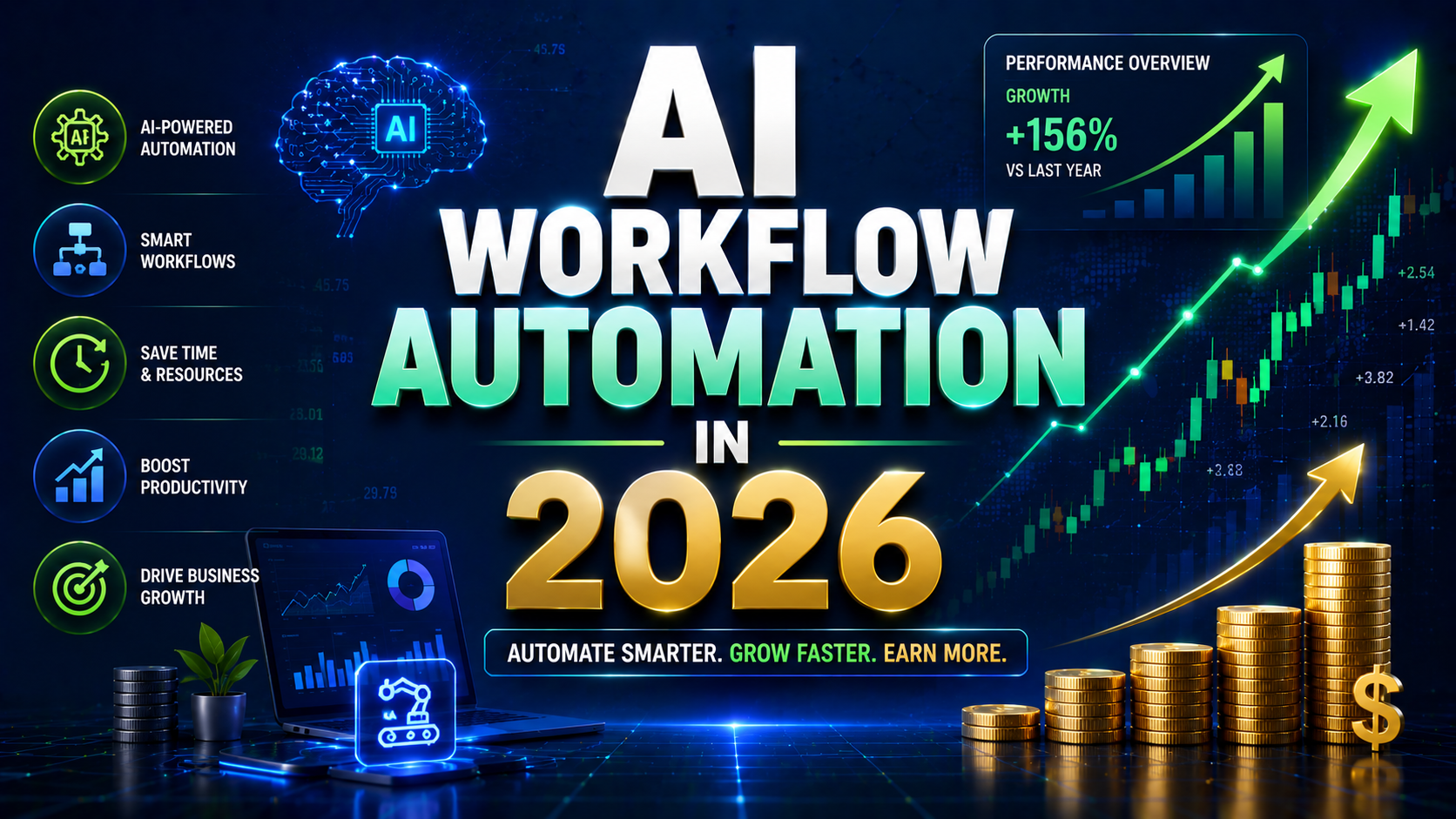
AI Workflow Automation in 2026: How Businesses Are Replacing Manual Operations with Intelligent Systems.
Businesses today are under constant pressure to improve efficiency, reduce operational costs, and scale faster than competitors. However, many organizations still rely on outdated manual processes that consume time, increase human error, and slow growth.
This is where AI workflow automation is changing the game.
In 2026, companies are rapidly adopting intelligent automation systems that can automate repetitive tasks, analyze data, make decisions, and optimize workflows with minimal human involvement.
From marketing and finance to ecommerce and customer support, AI-powered systems are transforming traditional operations into scalable digital ecosystems.
The future of business is no longer just automation. It is autonomous intelligent workflow management.
What is AI Workflow Automation?
AI workflow automation refers to the use of artificial intelligence technologies to automate business processes, repetitive tasks, and operational workflows.
Unlike traditional automation tools that follow fixed rules, AI-powered systems can:
- learn from data
- adapt to changing conditions
- make decisions
- optimize workflows continuously
Simple Definition:
AI workflow automation uses intelligent software systems to automate tasks and business operations with minimal manual intervention.
Why AI Workflow Automation is Exploding in 2026
Several factors are driving rapid adoption across industries.
Key Growth Drivers
1. Rising Operational Costs
Businesses need automation to reduce labor expenses and improve productivity.
2. Remote & Digital Work Environments
Companies require scalable systems that work 24/7.
3. Data Overload
AI helps process massive amounts of business data faster than humans.
4. Customer Expectations
Consumers now expect instant responses and personalized experiences.
5. Advances in AI Technology
Modern AI automation tools are becoming more affordable and accessible.
AI Workflow Automation vs Traditional Automation
| Feature | Traditional Automation | AI Workflow Automation |
|---|---|---|
| Logic Type | Rule-based | Intelligent & adaptive |
| Learning Capability | None | Continuous learning |
| Decision Making | Limited | Advanced |
| Flexibility | Low | High |
| Data Analysis | Basic | Real-time insights |
| Optimization | Manual | Automated |
Key Insight:
Traditional automation follows instructions.
AI automation improves workflows automatically over time.
How Intelligent Automation Systems Work
Modern intelligent automation systems combine multiple technologies:
- Artificial Intelligence
- Machine Learning
- Natural Language Processing
- Robotic Process Automation (RPA)
- Cloud Computing
- APIs & Integrations
Step-by-Step Workflow
Step 1: Data Collection
AI gathers information from:
- emails
- CRMs
- websites
- spreadsheets
- cloud platforms
Step 2: Pattern Analysis
AI identifies trends, behaviors, and workflow bottlenecks.
Step 3: Decision Making
The system determines the best action automatically.
Step 4: Task Execution
AI executes workflows such as:
- sending emails
- updating records
- generating reports
- customer communication
Step 5: Continuous Optimization
AI learns from performance and improves future outputs.
Real-World Use Cases of AI Workflow Automation
H3: 1. Marketing Automation
Marketing teams are using AI automation tools for:
- email campaigns
- content generation
- SEO optimization
- lead scoring
- ad campaign management
Example:
An AI system can:
- identify customer behavior
- segment audiences
- create personalized email campaigns
- optimize ad spend automatically
2. Ecommerce Automation
Ecommerce businesses are automating:
- inventory management
- order processing
- customer support
- product recommendations
- pricing optimization
Business Impact:
Faster fulfillment and improved customer experience.
3. Finance & Accounting Automation
AI systems help finance teams with:
- invoice processing
- fraud detection
- expense tracking
- financial forecasting
- compliance reporting
Benefits:
- reduced manual errors
- real-time reporting
- faster approvals
4. Customer Support Automation
AI-powered support systems now provide:
- chatbot assistance
- automated ticket routing
- sentiment analysis
- multilingual support
- CRM integration
Result:
Businesses can deliver 24/7 customer service efficiently.
5. Human Resource Automation
HR departments automate:
- resume screening
- employee onboarding
- payroll workflows
- attendance management
- performance tracking
Best AI Automation Tools Businesses are Using in 2026
Several platforms are leading the automation revolution.
| Tool Category | Examples |
|---|---|
| Workflow Automation | Zapier, Make |
| AI Productivity | Notion |
| CRM Automation | HubSpot |
| AI Content Tools | OpenAI |
| Enterprise Automation | UiPath |
Rise of No-Code Automation Platforms
One major trend in 2026 is the growth of no-code automation platforms.
These platforms allow non-technical users to create automation workflows without programming knowledge.
Why No-Code is Growing
- lower development costs
- faster deployment
- easy integrations
- business-friendly interfaces
Example Use Cases:
- automate email notifications
- connect ecommerce systems
- sync customer data
- generate analytics reports
Step-by-Step Framework to Implement AI Workflow Automation
Step 1: Identify Repetitive Tasks
Focus on high-volume manual activities.
Examples:
- data entry
- reporting
- approvals
- customer queries
Step 2: Define Automation Goals
Set measurable objectives such as:
- reduce processing time by 50%
- lower operational costs
- improve response rates
Step 3: Choose the Right AI Automation Tools
Evaluate:
- scalability
- integrations
- pricing
- security
- ease of use
Step 4: Start Small
Avoid automating everything immediately.
Begin with:
- simple workflows
- low-risk operations
- repetitive tasks
Step 5: Monitor Performance
Track:
- productivity improvements
- ROI
- error reduction
- workflow efficiency
Step 6: Scale Gradually
Expand automation into:
- marketing
- finance
- operations
- customer service
Common Mistakes Businesses Make
1. Automating Broken Processes
Poor workflows become worse with automation.
2. Ignoring Human Oversight
AI still requires monitoring and quality control.
3. Choosing Too Many Tools
Tool overload creates integration problems.
4. Lack of Employee Training
Teams need automation awareness and workflow education.
5. Unrealistic Expectations
AI improves efficiency but requires optimization.
Expert Tips for Successful Automation
Pro Insights
✔ prioritize ROI-focused workflows
✔ integrate AI with existing systems
✔ maintain data quality standards
✔ combine AI with human decision-making
✔ monitor workflow analytics continuously
Strategic Recommendation:
Businesses should focus on human-AI collaboration, not complete workforce replacement.
Future Trends in AI Workflow Automation
1. Autonomous AI Agents
AI systems will independently manage complex workflows.
2. Hyperautomation
Businesses will combine AI, RPA, analytics, and machine learning into unified ecosystems.
3. AI Decision Intelligence
AI will support executive-level strategic decisions.
4. Voice & Conversational Automation
Voice-based AI workflows will increase.
5. Predictive Workflow Optimization
AI will predict workflow failures before they occur.
How AI Workflow Automation Impacts Jobs
AI is transforming work rather than eliminating all jobs.
Roles Likely to Change
- data entry
- repetitive support roles
- manual reporting
- administrative processing
New Career Opportunities
- AI workflow consultants
- automation specialists
- AI integration experts
- prompt engineers
- data analysts
Key Takeaways
- AI workflow automation improves business efficiency and scalability.
- Intelligent automation systems outperform traditional rule-based automation.
- No-code automation platforms are making AI accessible to all businesses.
- Companies adopting AI automation early gain competitive advantages.
- Human + AI collaboration is the future of digital business operations.
Conclusion
AI workflow automation is rapidly becoming the operational backbone of modern businesses. Companies that continue relying on manual systems will struggle to compete in a fast-moving digital economy.
The organizations leading in 2026 are those leveraging:
- intelligent automation systems
- AI automation tools
- workflow automation software
- no-code automation platforms
The future is not simply automated. It is intelligently autonomous.
Businesses that invest early in AI-powered workflows will achieve:
- higher productivity
- lower operational costs
- better customer experiences
- long-term scalability
The automation revolution has already started. The next step is strategic adoption.
FAQ:
1. What is AI workflow automation?
AI workflow automation uses artificial intelligence to automate business tasks, workflows, and operational processes with minimal manual effort.
2. How is AI automation different from traditional automation?
Traditional automation follows fixed rules, while AI automation can learn, adapt, and optimize workflows dynamically.
3. What industries benefit most from workflow automation?
Marketing, ecommerce, finance, healthcare, HR, logistics, and customer service industries benefit significantly.
4. Are no-code automation platforms useful for small businesses?
Yes. No-code platforms allow small businesses to automate workflows without technical expertise.
5. Will AI workflow automation replace jobs?
AI mainly replaces repetitive tasks while creating new roles focused on AI management, strategy, and optimization.