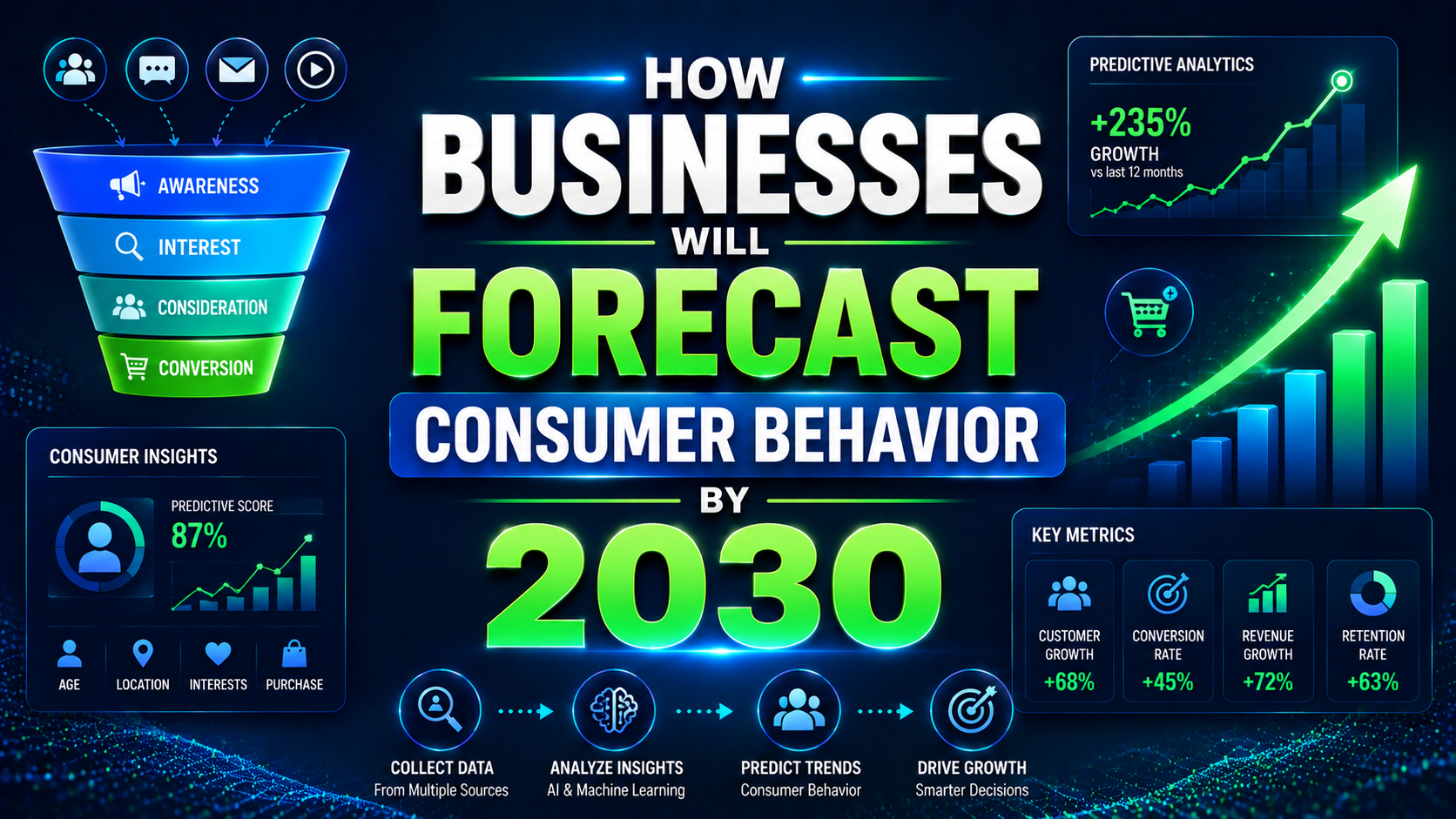
AI-Powered Predictive Market Research: How Businesses Will Forecast Consumer Behavior in 2030.
Traditional market research is no longer enough in a world driven by real-time data, artificial intelligence, and rapidly changing consumer behavior.
Businesses today face major challenges:
- unpredictable customer preferences
- fast-changing trends
- increasing competition
- shorter attention spans
- rising customer acquisition costs
By 2030, companies that rely only on surveys and historical reports may struggle to stay competitive.
The future belongs to businesses using:
- AI predictive market research
- predictive consumer analytics
- real-time behavioral forecasting
- AI-driven customer intelligence
Artificial intelligence is transforming how businesses understand customers, predict buying decisions, and identify future trends before competitors.
This guide explains the future of market research, how AI forecasting works, real-world use cases, and the strategies businesses will use to forecast consumer behavior by 2030.
What is AI Predictive Market Research?
AI predictive market research uses artificial intelligence, machine learning, behavioral analytics, and big data to forecast future consumer trends and buying patterns.
Unlike traditional market research, predictive research focuses on:
- forecasting future behavior
- identifying emerging trends
- predicting demand shifts
- analyzing real-time customer intent
Simple Definition:
AI predictive market research helps businesses predict what customers are likely to do before they make decisions.
Why Traditional Market Research is Changing
Traditional market research methods include:
- surveys
- focus groups
- questionnaires
- interviews
- historical sales analysis
While useful, these methods have limitations:
- slow data collection
- delayed insights
- small sample sizes
- outdated information
- human bias
Modern consumers generate enormous digital behavior signals every second.
AI systems can analyze:
- search behavior
- social media activity
- browsing patterns
- purchase history
- voice search interactions
- engagement signals
This creates faster and more accurate market intelligence.
Why AI Predictive Market Research Matters in 2030
The future marketplace will become increasingly:
- personalized
- automated
- data-driven
- behavior-focused
Businesses that predict trends early gain competitive advantage.
Key Benefits
Faster Decision Making
AI analyzes large datasets instantly.
Improved Consumer Forecasting
Businesses identify future customer preferences earlier.
Better Product Development
Companies build products based on predicted demand.
Reduced Marketing Waste
AI helps optimize targeting and campaign spending.
Higher Customer Retention
Predictive systems identify churn risks early.
How AI Consumer Behavior Forecasting Works
AI systems analyze massive amounts of structured and unstructured data.
Data Sources Used
- website analytics
- social media interactions
- CRM systems
- purchase behavior
- mobile app activity
- customer reviews
- online search trends
- geographic behavior patterns
Machine learning algorithms identify:
- patterns
- correlations
- behavioral trends
- future probabilities
Core Technologies Behind Predictive Consumer Analytics
Machine Learning (ML)
Machine learning identifies hidden behavioral patterns.
ML continuously improves prediction accuracy over time.
Natural Language Processing (NLP)
NLP analyzes:
- customer reviews
- social media comments
- feedback messages
This helps businesses understand sentiment and intent.
Predictive Analytics
Predictive analytics forecasts future outcomes using historical and behavioral data.
Behavioral Analytics
Behavioral analytics tracks:
- user engagement
- browsing habits
- click patterns
- purchase journeys
AI Sentiment Analysis
AI detects customer emotions and opinions.
Brands can identify:
- satisfaction
- frustration
- excitement
- loyalty
Step-by-Step AI Market Insights Strategy
Step 1: Collect Consumer Data
Businesses gather data from:
- websites
- apps
- customer interactions
- search engines
- social platforms
Data quality is critical.
Step 2: Organize and Clean Data
AI systems require structured and accurate data.
Remove:
- duplicate records
- irrelevant information
- outdated data
Step 3: Analyze Behavioral Patterns
AI identifies:
- buying triggers
- customer segments
- behavioral clusters
- seasonal trends
Step 4: Predict Future Actions
Predictive models forecast:
- purchase likelihood
- churn probability
- future demand
- market shifts
Step 5: Implement Strategic Decisions
Businesses use insights to:
- personalize marketing
- optimize inventory
- launch products
- improve targeting
Real-World Examples of Predictive Consumer Analytics
Example 1: eCommerce Product Recommendations
Online retailers analyze browsing behavior to predict future purchases.
AI recommends products based on:
- customer preferences
- search history
- buying patterns
Example 2: Streaming Platform Recommendations
Streaming services predict viewing preferences using behavioral analysis.
This improves engagement and retention.
Example 3: Retail Demand Forecasting
Retailers forecast seasonal demand using:
- historical sales
- search trends
- regional behavior
Example 4: Financial Risk Prediction
Financial companies use predictive analytics to identify customer risk behavior.
Future of Market Research in 2030
The future of market research will become increasingly:
- predictive
- automated
- personalized
- AI-driven
Traditional surveys alone will no longer dominate research strategies.
Emerging Market Intelligence Trends 2030
Real-Time Consumer Intelligence
Businesses will monitor live customer behavior continuously.
Hyper-Personalized Insights
AI will predict individual preferences at micro-level precision.
Voice & Visual Search Analytics
Consumer intent from:
- voice assistants
- image search
- video interactions
will become valuable research signals.
Emotion AI and Sentiment Mapping
AI will detect emotional behavior patterns more accurately.
Predictive Trend Forecasting
AI systems will forecast:
- viral trends
- market demand
- consumer shifts
before they become mainstream.
Actionable Strategies for Businesses
Invest in First-Party Data Collection
Own customer data becomes increasingly valuable.
Build AI-Ready Data Infrastructure
Organized data improves forecasting accuracy.
Combine Human Insights with AI
Human interpretation remains important.
AI supports decision-making, not complete replacement.
Focus on Ethical Data Usage
Transparency improves customer trust.
Continuously Monitor Consumer Trends
Consumer behavior changes rapidly.
Regular analysis is essential.
Common Mistakes to Avoid
Relying Only on Historical Data
Past behavior does not always predict future behavior.
Ignoring Data Privacy Regulations
Privacy compliance is critical.
Poor Data Quality Management
Inaccurate data produces weak predictions.
Over-Automating Decision Making
Human expertise remains necessary.
Lack of Cross-Channel Data Integration
Disconnected data limits forecasting capability.
Expert Tips for AI Market Research Success
Prioritize Data Accuracy
High-quality data improves AI reliability.
Focus on Consumer Intent
Intent signals are more valuable than vanity metrics.
Use Multi-Channel Behavioral Analysis
Analyze customer behavior across platforms.
Develop Topical Intelligence Systems
Topic-based market analysis improves future forecasting.
Continuously Train AI Models
AI systems improve through ongoing learning.
Future Predictions for AI Consumer Forecasting (2030–2035)
AI Will Predict Needs Before Customers Search
Predictive commerce will expand rapidly.
Hyper-Personalization Will Become Standard
AI-driven experiences will dominate digital marketing.
Autonomous Market Research Systems
AI agents may conduct automated market intelligence analysis.
AI + Neuroscience Integration
Consumer emotion tracking may improve significantly.
Predictive Customer Journey Mapping
Businesses will forecast entire customer journeys.
Key Takeaways
- AI predictive market research transforms future decision making
- predictive consumer analytics improves customer forecasting
- AI analyzes real-time behavioral data
- businesses gain competitive advantage through forecasting
- market intelligence trends 2030 focus on automation and personalization
- ethical data practices remain critical
Conclusion
The future of market research is shifting from reactive analysis to predictive intelligence.
Businesses that adopt:
- AI predictive market research
- behavioral analytics
- predictive consumer forecasting
- AI market insights strategy
will gain stronger competitive advantages in the evolving digital economy.
By 2030, successful companies will no longer wait for trends to happen.
They will predict them before the market changes.
AI-powered market intelligence will become one of the most valuable business assets of the next decade.
FAQ
1. What is AI predictive market research?
AI predictive market research uses artificial intelligence and analytics to forecast future consumer behavior and market trends.
2. How does predictive consumer analytics work?
It analyzes behavioral data, patterns, and trends to predict future customer actions.
3. Why is AI important in the future of market research?
AI improves speed, accuracy, personalization, and forecasting capability.
4. What are market intelligence trends in 2030?
Real-time analytics, hyper-personalization, predictive forecasting, and AI-driven automation.
5. Can AI fully replace traditional market research?
No. AI enhances research, but human interpretation and strategic thinking remain important.