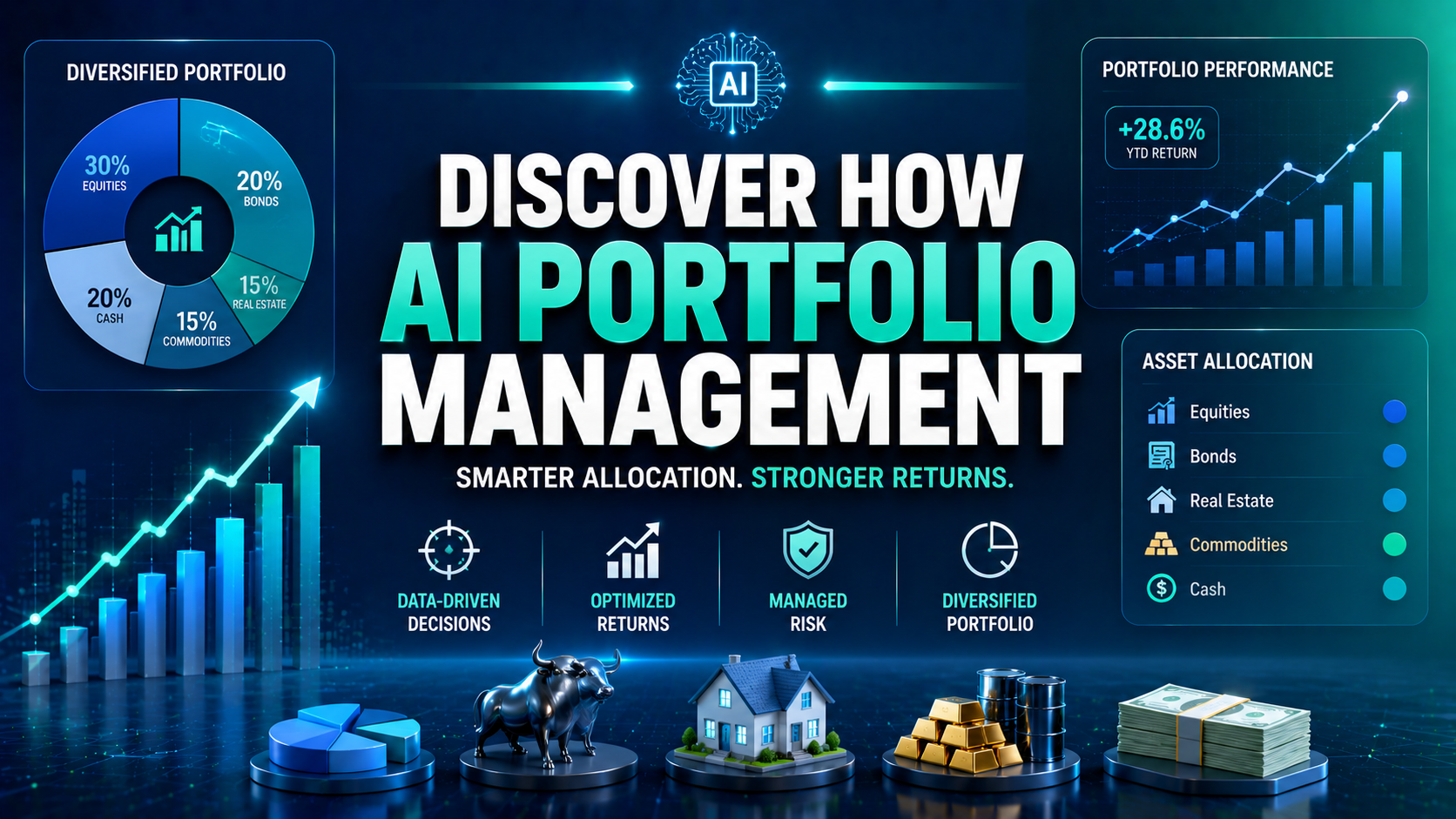
AI-Powered Portfolio Management: How Artificial Intelligence Will Transform Investment Strategies.
The investment industry is entering a new era.
For decades, portfolio management relied heavily on human advisors, manual research, historical performance analysis, and investor intuition. While these methods remain valuable, today’s investors face an increasingly complex financial environment filled with massive amounts of data, rapid market movements, and global economic uncertainty.
This is where AI portfolio management is changing the game.
Artificial intelligence is helping investors build smarter portfolios, optimize risk management, automate portfolio rebalancing, and uncover opportunities that traditional methods may miss.
As machine learning technology continues to evolve, many experts believe that artificial intelligence investing could become one of the most important developments in modern finance.
But how does it work?
Can AI really outperform traditional portfolio management?
And what does this mean for the future of investing?
Let’s explore.
What Is AI-Powered Portfolio Management?
AI-powered portfolio management uses artificial intelligence, machine learning, predictive analytics, and automation to help investors make better investment decisions.
Unlike traditional portfolio management, AI systems can analyze millions of data points simultaneously.
These systems evaluate:
- Market trends
- Economic indicators
- Company financial data
- Investor sentiment
- Portfolio risk exposure
- Asset correlations
- Historical performance patterns
The goal is to improve portfolio performance while managing risk more efficiently.
Why Traditional Portfolio Management Is Changing
Investment markets have become increasingly data-driven.
Consider the volume of information generated daily:
- Corporate earnings reports
- Global economic releases
- Central bank decisions
- News events
- Social media discussions
- Market sentiment indicators
Human advisors can analyze only a limited amount of information.
AI systems can process enormous datasets within seconds.
This ability is driving the growth of automated portfolio management solutions worldwide.
How AI Builds Personalized Investment Portfolios
One of the most powerful advantages of AI is personalization.
Traditional investment models often place investors into broad categories.
AI can create highly customized portfolios based on individual factors.
Data Points AI Can Analyze
Investor Profile
- Age
- Income
- Risk tolerance
- Financial goals
- Investment timeline
Market Conditions
- Inflation
- Interest rates
- Economic cycles
- Sector performance
Behavioral Patterns
- Spending habits
- Investing behavior
- Risk preferences
The result is a portfolio specifically designed for the investor’s unique situation.
Machine Learning in Asset Allocation
Asset allocation is one of the most important factors in long-term investment success.
Traditional models use fixed allocation rules.
Machine learning continuously evaluates changing market conditions and adjusts recommendations accordingly.
Example
A traditional allocation might be:
- 60% stocks
- 30% bonds
- 10% cash
An AI-driven system may detect:
- Rising inflation
- Economic slowdown
- Increased market volatility
The system can then recommend adjustments based on real-time data.
This is known as AI asset allocation.
AI-Driven Portfolio Rebalancing
Portfolio rebalancing is essential for maintaining investment goals.
Over time, market movements can change portfolio allocations.
For example:
Original Portfolio:
- Stocks: 60%
- Bonds: 30%
- Cash: 10%
After a strong stock market rally:
- Stocks: 75%
- Bonds: 18%
- Cash: 7%
This increases portfolio risk.
AI systems automatically identify allocation drift and recommend rebalancing actions.
Benefits include:
- Reduced risk exposure
- Better portfolio discipline
- Improved consistency
- Lower emotional decision-making
Benefits of AI Portfolio Management
1. Faster Data Processing
AI can analyze massive datasets much faster than humans.
This improves decision-making speed.
2. Better Risk Management
AI continuously monitors:
- Market volatility
- Asset concentration
- Correlation risks
This helps investors avoid excessive exposure.
3. Reduced Emotional Investing
Fear and greed often damage investment performance.
AI follows data and predefined rules rather than emotions.
4. Personalized Investment Strategies
AI adapts recommendations to each investor’s profile.
No two portfolios need to be identical.
5. Continuous Portfolio Optimization
AI never stops analyzing.
It continuously searches for opportunities and risks.
Human Advisors vs AI Advisors
Many investors ask:
Will AI replace financial advisors?
The answer is likely no.
Instead, AI will enhance human expertise.
Human Advisors Excel At
- Understanding personal goals
- Emotional coaching
- Estate planning
- Tax strategy
- Complex financial decisions
AI Excels At
- Data analysis
- Pattern recognition
- Portfolio optimization
- Real-time monitoring
- Automated execution
The future may belong to a hybrid model combining both strengths.
Real-World Applications of AI in Investing
Robo-Advisors
Modern robo-advisors already use AI to:
- Create portfolios
- Manage allocations
- Rebalance investments
- Optimize risk levels
Predictive Analytics
AI models analyze historical data to identify potential market opportunities.
This helps investors make more informed decisions.
Sentiment Analysis
AI scans:
- News articles
- Financial reports
- Social media discussions
It then measures market sentiment and potential investor reactions.
Wealth Management Platforms
Large investment firms increasingly use AI to support research and portfolio management decisions.
Step-by-Step Framework for Using AI in Portfolio Management
Step 1: Define Financial Goals
Determine whether your objective is:
- Retirement planning
- Wealth creation
- Passive income
- Capital preservation
Step 2: Assess Risk Tolerance
Understand how much volatility you can handle.
AI systems use this information when building portfolios.
Step 3: Select AI Investment Tools
Choose reputable platforms with:
- Transparent methodologies
- Risk controls
- Portfolio reporting
- Rebalancing capabilities
Step 4: Monitor Performance
Review portfolio performance periodically.
AI should support decision-making, not replace oversight.
Step 5: Continue Learning
Technology evolves rapidly.
Investors should stay informed about AI-driven investing trends.
Common Mistakes to Avoid
Blindly Trusting AI
AI improves probabilities but cannot predict markets perfectly.
Ignoring Fundamentals
Strong investment decisions still require understanding businesses and economic conditions.
Chasing Short-Term Signals
Long-term investing remains important.
Over-Reliance on Automation
Human judgment still matters.
Choosing Unverified Platforms
Not all AI investment tools are equally reliable.
Research before investing.
Expert Tips for Successful AI Investing
Focus on Long-Term Goals
AI works best when combined with long-term discipline.
Diversify Across Asset Classes
Avoid concentration risk.
Review Portfolio Regularly
Technology should complement oversight.
Understand the Strategy
Never invest in something you do not understand.
Combine Human and AI Insights
The strongest investment decisions often use both.
Future Trends in AI-Powered Wealth Management
The next decade could transform investing dramatically.
Emerging Trends
Hyper-Personalized Portfolios
AI will create portfolios tailored to individual financial behavior.
Predictive Risk Management
Systems will identify risks before they become significant threats.
Real-Time Portfolio Optimization
Portfolios may adjust continuously based on changing conditions.
AI Financial Assistants
Investors may use conversational AI for portfolio guidance and planning.
Alternative Asset Integration
AI may help investors manage exposure across:
- Stocks
- Bonds
- Real estate
- Cryptocurrency
- Private equity
- Tokenized assets
How AI Overviews and AI Search Are Influencing Investing Research
Search behavior is changing.
Investors increasingly rely on:
- AI search engines
- AI-powered financial assistants
- AI-generated market summaries
This trend is creating new opportunities for investors to access information faster and make more informed decisions.
As AI search technology improves, investment research will become more personalized and accessible.
Summary / Key Takeaways
- AI portfolio management is transforming modern investing.
- Machine learning improves asset allocation decisions.
- AI-driven portfolio rebalancing enhances discipline and risk control.
- Automated portfolio management can process vast amounts of data quickly.
- AI reduces emotional investing and supports data-driven decisions.
- Human expertise remains valuable alongside AI technology.
- The future of investing will likely combine automation, personalization, and human judgment.
FAQ
1. What is AI portfolio management?
AI portfolio management uses artificial intelligence and machine learning to build, monitor, optimize, and rebalance investment portfolios automatically.
2. Can AI manage an investment portfolio better than humans?
AI excels at data analysis and automation, while humans provide strategic judgment and emotional guidance. The best results often come from combining both.
3. What is AI asset allocation?
AI asset allocation uses machine learning models to recommend investment allocations based on market conditions, risk tolerance, and financial goals.
4. Is automated portfolio management safe?
Automated portfolio management can improve efficiency and consistency, but investors should still monitor performance and understand associated risks.
5. What is the future of AI in investing?
The future includes hyper-personalized portfolios, predictive analytics, intelligent risk management, AI financial assistants, and real-time portfolio optimization.
Conclusion
Artificial intelligence is no longer a futuristic concept in investing—it is rapidly becoming a core component of modern portfolio management.
From AI asset allocation and automated portfolio management to predictive analytics and intelligent rebalancing, AI is helping investors navigate increasingly complex financial markets with greater confidence.
While AI will not replace human judgment entirely, it is transforming how investment decisions are made. Investors who understand and leverage these technologies today will be better positioned for the evolving future of investing.
The next generation of wealth management will not be powered solely by humans or machines—it will be powered by the intelligent combination of both.