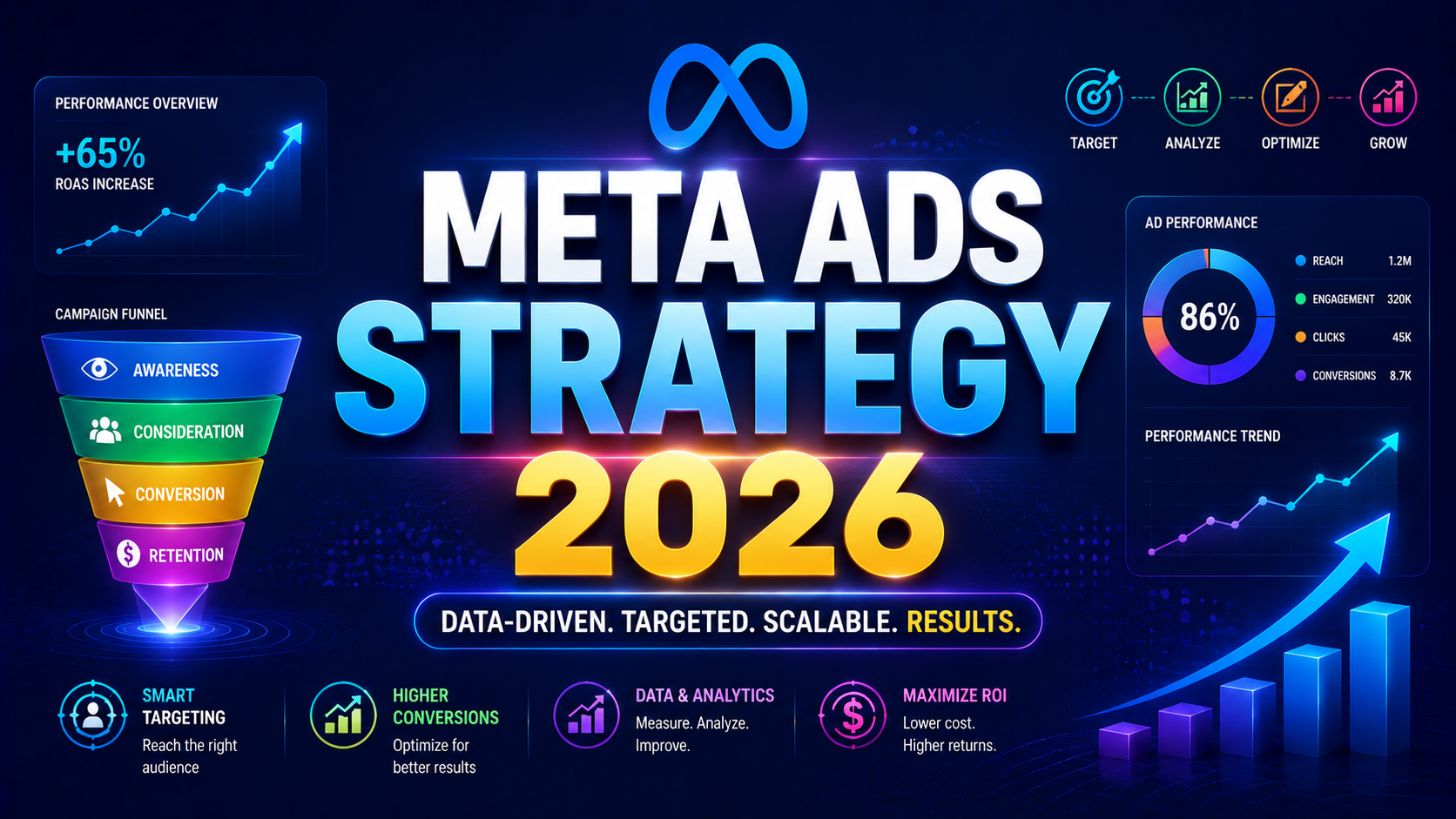
Meta Ads Strategy 2026: How to Scale Profitable Campaigns with Advantage+ AI
Introduction
Digital advertising is changing faster than ever.
Meta has transformed Facebook and Instagram advertising from manually optimized campaigns into an AI-driven advertising ecosystem where automation, machine learning, predictive audience targeting, and creative optimization play a central role.
Many advertisers still rely on campaign structures that worked three or four years ago. As a result, they often experience:
- Rising Cost Per Click (CPC)
- Increasing Cost Per Acquisition (CPA)
- Declining Return on Ad Spend (ROAS)
- Reduced audience engagement
- Creative fatigue
- Poor campaign scalability
In 2026, success with Meta advertising is no longer about making hundreds of manual adjustments. Instead, it depends on working with Meta’s AI systems rather than against them.
The introduction of Advantage+ Shopping Campaigns, AI-powered audience expansion, automated budget allocation, Dynamic Creative, and predictive optimization has fundamentally changed how successful campaigns are built.
Whether you run an eCommerce store, generate leads for a service business, or promote a local brand, understanding the latest Meta Ads strategy can significantly improve campaign performance.
In this guide, you’ll learn:
- How the Meta Ads algorithm works in 2026
- What Advantage+ AI does
- When to use Advantage+ versus manual campaigns
- The best campaign structures for eCommerce and lead generation
- Practical strategies to improve profitability
What is Meta Ads Strategy?
A Meta Ads strategy is a structured plan for creating, targeting, optimizing, and scaling advertising campaigns across Facebook, Instagram, Messenger, and the Audience Network.
Rather than simply boosting posts, an effective strategy aligns campaign objectives with business goals, audience intent, creative assets, and conversion optimization.
A modern Meta Ads strategy includes:
- Campaign objective selection
- Audience targeting
- Creative development
- Budget management
- AI-powered optimization
- Conversion tracking
- Performance analysis
The goal is not just to increase impressions or clicks, but to generate measurable business outcomes such as qualified leads, online sales, app installs, or customer retention.
Why Meta Ads Still Matter in 2026
Despite the growth of AI-powered search and new social platforms, Meta remains one of the largest digital advertising ecosystems.
Key advantages include:
- Massive global audience across Facebook and Instagram
- Advanced AI-driven targeting
- Rich first-party user signals
- Diverse ad formats (Reels, Stories, Feed, Video, Carousel, Collection)
- Strong support for eCommerce and lead generation
- Integrated analytics and conversion measurement
For businesses that combine compelling creative with smart optimization, Meta Ads continue to deliver scalable results across industries.
How the Meta Ads Algorithm Works in 2026
Meta’s advertising algorithm uses machine learning to predict which users are most likely to complete your desired action—such as making a purchase, submitting a lead form, or installing an app.
Instead of relying solely on demographic filters, the algorithm evaluates hundreds of signals, including:
- Browsing behavior
- Purchase history
- Engagement patterns
- Device usage
- Content interactions
- Video watch time
- Similar audience behavior
- Historical conversion data
These signals help Meta determine where your ads are most likely to perform well.
The Five Key Ranking Signals
1. Estimated Action Rate
The algorithm predicts the likelihood that a user will complete your optimization event.
For example:
- Purchase
- Add to Cart
- Lead Submission
- Registration
Higher predicted conversion probability generally improves delivery.
2. Ad Quality
Meta evaluates whether users find your ad relevant and engaging.
Signals include:
- Positive engagement
- Negative feedback
- User reports
- Click quality
- Landing page experience
High-quality ads are rewarded with more efficient delivery.
3. User Relevance
Ads closely aligned with a user’s interests and behavior are more likely to win auctions and receive impressions.
This is why broad audiences combined with strong creative often outperform overly restrictive targeting.
4. Historical Performance
Campaigns that consistently generate strong engagement and conversions provide valuable learning signals, allowing the algorithm to optimize future delivery more effectively.
Frequent unnecessary edits can interrupt this learning process.
5. AI Learning Phase
Every new campaign enters a learning phase where Meta tests different combinations of audiences, placements, and creatives.
During this period:
- Performance may fluctuate.
- Costs may be higher.
- Stable budgets and limited edits help the algorithm learn faster.
Allow sufficient data before making major changes.
Understanding Advantage+ Shopping Campaigns
One of the most significant advancements in Meta advertising is Advantage+ Shopping Campaigns (ASC).
These campaigns use AI to automate many optimization tasks that advertisers previously handled manually.
Advantage+ can optimize:
- Audience selection
- Budget distribution
- Placement choices
- Creative delivery
- Bidding strategies
- Conversion optimization
The objective is to maximize conversions while reducing manual effort.
Best Use Cases
Advantage+ Shopping Campaigns are particularly effective for:
- eCommerce brands
- Direct-to-consumer (D2C) businesses
- Retail stores
- Product launches
- Catalog sales
- Brands with sufficient conversion history
Advantage+ Campaigns vs Manual Campaigns
| Feature | Advantage+ Campaigns | Manual Campaigns |
|---|---|---|
| Audience Selection | AI-driven | Advertiser-defined |
| Budget Allocation | Automated | Manual |
| Placement Optimization | Automatic | Manual or automatic |
| Creative Delivery | Dynamic | Controlled |
| Learning Speed | Faster with sufficient data | Depends on optimization |
| Ease of Management | High | Moderate to High |
| Best For | Scaling and eCommerce | Specialized targeting and niche campaigns |
When to Use Advantage+
Choose Advantage+ when:
- You have consistent conversion data.
- You manage multiple products.
- You want to scale efficiently.
- You prefer AI-driven optimization.
When Manual Campaigns Are Better
Manual campaigns remain valuable when:
- Launching a new brand with limited data.
- Targeting niche B2B audiences.
- Testing highly specific messaging.
- Running localized campaigns.
- Validating new creative concepts.
Many experienced advertisers combine both approaches, using manual campaigns for testing and Advantage+ for scaling proven winners.
Best Campaign Structure for eCommerce
A well-organized campaign structure helps Meta’s AI optimize efficiently while keeping reporting manageable.
Recommended Framework
Campaign 1: Prospecting
Objective: Sales
Audience:
- Broad audience
- Advantage+ Audience
- Interest expansion
Creative:
- Product videos
- Reels
- Lifestyle images
- UGC-style content
Campaign 2: Retargeting
Target users who:
- Viewed products
- Added items to cart
- Visited your website
- Engaged with Instagram or Facebook content
Creative focus:
- Customer testimonials
- Limited-time offers
- Social proof
- Product demonstrations
Campaign 3: Loyalty & Repeat Purchases
Target:
- Existing customers
- Recent buyers
- High-value customer segments
Objectives:
- Upsell
- Cross-sell
- Repeat purchases
- New product launches
This three-layer structure aligns well with the customer journey while allowing Meta’s AI to optimize delivery at each stage.
Best Campaign Structure for Lead Generation
For service-based businesses, education providers, healthcare, or SaaS companies, a lead generation framework is often more effective.
Campaign 1: Awareness
Focus on:
- Educational videos
- Industry insights
- Problem-awareness content
Objective:
- Video Views
- Engagement
- Traffic
Campaign 2: Lead Capture
Use:
- Instant Forms
- Landing Pages
- Free consultations
- Webinar registrations
- Downloadable resources
Objective:
- Leads
- Conversions
Campaign 3: Lead Nurturing
Retarget:
- Form opens without submission
- Website visitors
- Video viewers
- Email subscribers
Creative:
- Success stories
- Case studies
- Testimonials
- FAQs
- Special offers