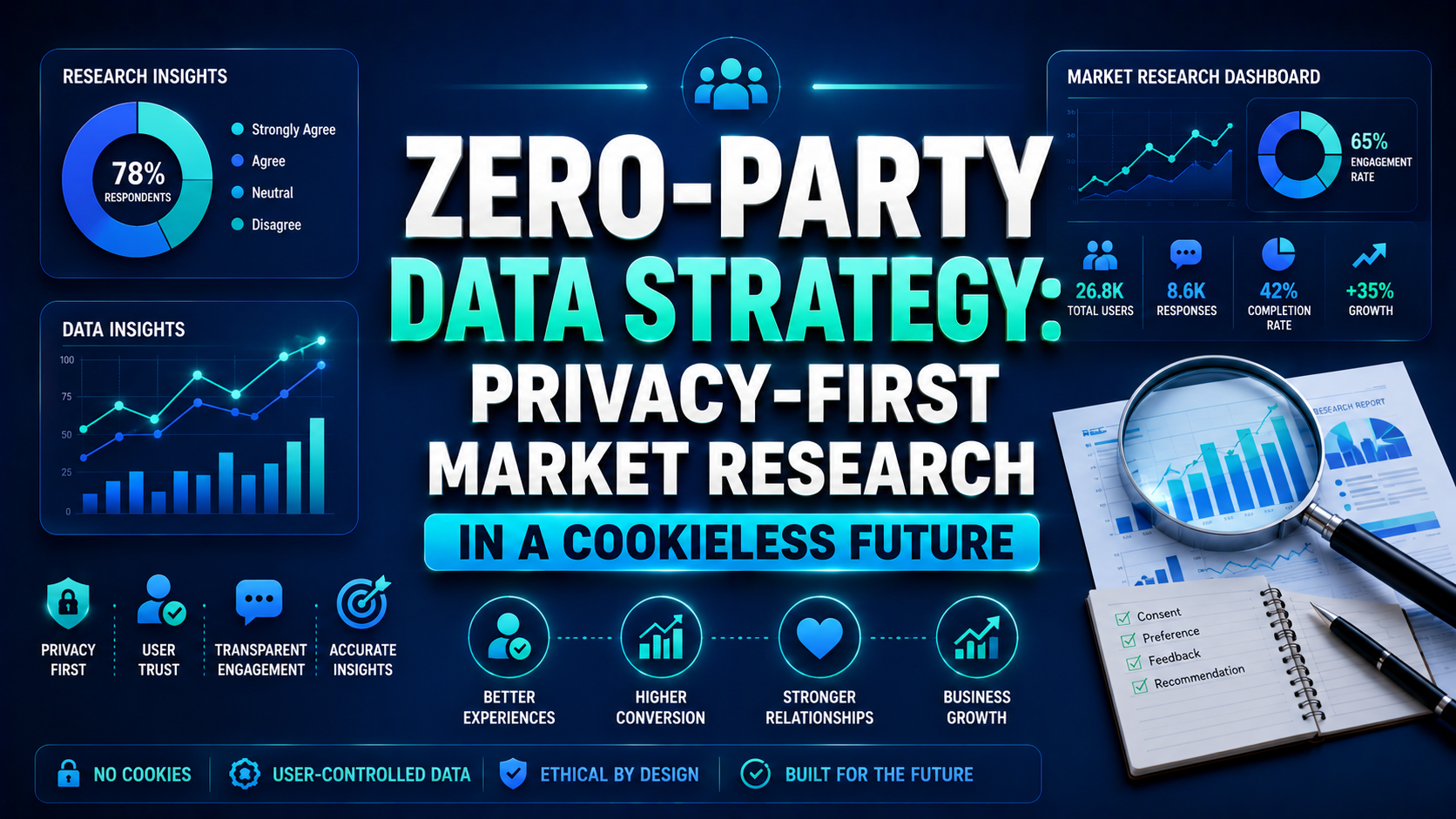
Zero-Party Data Strategy: The Future of Privacy-First Market Research in a Cookieless World
Introduction: The End of Third-Party Cookies Is Reshaping Marketing
For more than two decades, marketers relied heavily on third-party cookies to track consumer behavior across the internet.
These cookies powered:
- audience targeting
- behavioral advertising
- customer profiling
- retargeting campaigns
- market research initiatives
However, growing concerns about privacy, data ownership, and consumer rights have fundamentally changed the landscape.
Consumers today demand:
- transparency
- control over personal data
- ethical data usage
- privacy-focused experiences
At the same time, governments worldwide are introducing stricter privacy regulations.
This shift is driving businesses toward a new model of customer intelligence:
Zero-Party Data Strategy
In a cookieless future, organizations that build trust-based data relationships will gain a significant competitive advantage.
This guide explores how zero-party data is transforming market research, personalization, and customer intelligence in the privacy-first era.
What Is Zero-Party Data?
Zero-party data is information that customers intentionally and proactively share with a business.
Unlike inferred behavioral data, zero-party data is voluntarily provided.
Examples include:
- preferences
- interests
- purchase intentions
- communication preferences
- product needs
- personal goals
Simple Definition
Zero-party data is customer information willingly shared directly with a brand in exchange for a better experience.
The concept focuses on transparency and consent.
Why Zero-Party Data Matters in 2026 and Beyond
Consumers are becoming increasingly cautious about how companies collect and use data.
Trust has become a critical business asset.
Zero-party data helps businesses:
- improve personalization
- increase customer trust
- comply with privacy regulations
- reduce dependence on third-party tracking
- improve market research accuracy
Because customers intentionally provide information, the data is often more reliable than inferred behavioral signals.
Understanding the Customer Data Hierarchy
To understand the value of zero-party data, it helps to compare it with other data types.
Zero-Party Data
Shared directly by customers.
Examples:
- survey responses
- preference selections
- quizzes
- account settings
Highest transparency and trust level.
First-Party Data
Collected through customer interactions.
Examples:
- website behavior
- purchase history
- email engagement
- CRM records
Owned by the business.
Second-Party Data
Obtained through trusted partnerships.
Examples:
- partner audience insights
- collaborative research data
Third-Party Data
Collected by external organizations and sold to advertisers.
Examples:
- tracking cookies
- external audience datasets
This model is rapidly declining.
First-Party Data vs Third-Party Data vs Zero-Party Data
| Factor | Zero-Party Data | First-Party Data | Third-Party Data |
|---|---|---|---|
| Source | Customer directly | Customer interactions | External providers |
| Accuracy | Very High | High | Moderate |
| Consent | Explicit | Implied | Often indirect |
| Privacy Risk | Low | Moderate | High |
| Trust Level | Highest | High | Lowest |
| Future Viability | Very Strong | Strong | Declining |
The Cookieless Future: What It Means for Market Research
The phase-out of third-party cookies is transforming how businesses gather consumer insights.
Traditional tracking methods are becoming less reliable.
As a result, companies must rethink:
- customer segmentation
- audience targeting
- personalization
- market intelligence
The future of market research will depend more on direct customer relationships.
Why Traditional Tracking Is Losing Effectiveness
Several factors are accelerating change:
Privacy Regulations
Governments are strengthening privacy laws globally.
Consumers now have greater control over personal information.
Browser Restrictions
Modern browsers increasingly limit tracking capabilities.
This reduces third-party data availability.
Consumer Awareness
People are more aware of data collection practices than ever before.
Trust has become a major purchasing factor.
Privacy Regulations and Market Research
Privacy regulations are driving major changes in customer intelligence strategies.
Organizations must comply with evolving requirements around:
- consent
- transparency
- data storage
- user rights
Key Principles of Privacy-First Research
- informed consent
- clear disclosure
- data minimization
- secure storage
- customer control
Future market research strategies must prioritize ethical data collection.
AI + Consent-Based Personalization
Artificial intelligence is helping businesses create personalized experiences without violating privacy.
The combination of:
- AI
- zero-party data
- first-party data
creates powerful personalization opportunities.
How AI Uses Zero-Party Data
AI can analyze:
- stated preferences
- product interests
- customer goals
- communication choices
to deliver highly relevant experiences.
Examples include:
- personalized recommendations
- dynamic content
- customized email campaigns
- product suggestions
The key difference is that personalization happens with customer permission.
Building an Ethical Consumer Data Strategy
The future of customer intelligence depends on trust.
Businesses must create ethical frameworks for collecting and using data.
Step 1: Be Transparent
Clearly explain:
- what data is collected
- why it is needed
- how it will be used
Transparency builds confidence.
Step 2: Provide Value Exchange
Customers are more willing to share data when they receive value.
Examples:
- personalized recommendations
- exclusive content
- discounts
- customized experiences
Step 3: Collect Only Relevant Information
Avoid unnecessary data collection.
Focus on information that improves customer experience.
Step 4: Give Customers Control
Allow customers to:
- update preferences
- manage permissions
- delete information
Control increases trust.
Step 5: Protect Data Securely
Strong security practices are essential.
Data breaches destroy trust.
Zero-Party Data Collection Methods
Businesses can gather zero-party data through:
Interactive Surveys
Customers voluntarily share preferences.
Preference Centers
Users customize communication settings.
Product Recommendation Quizzes
Brands learn customer needs while providing value.
Polls and Feedback Forms
Simple and effective insight gathering.
Loyalty Programs
Members often provide preference information in exchange for rewards.
Real-World Applications of Zero-Party Data
eCommerce
Online stores collect:
- style preferences
- product interests
- purchase intentions
to improve recommendations.
SaaS Businesses
Software companies gather:
- business goals
- feature preferences
- usage requirements
to personalize onboarding.
Media Companies
Publishers use preference data to deliver relevant content experiences.
Subscription Services
Subscription businesses personalize offers using customer-provided information.
Common Mistakes to Avoid
Collecting Data Without Clear Purpose
Every question should provide business and customer value.
Overloading Customers
Too many questions reduce participation rates.
Poor Transparency
Customers should never feel surprised about data usage.
Ignoring Data Updates
Preferences change over time.
Data collection should be ongoing.
Prioritizing Quantity Over Quality
A small amount of accurate zero-party data is often more valuable than large volumes of inferred data.
Expert Tips for Privacy-First Market Research
Focus on Trust Before Data
Trust increases participation.
Make Data Sharing Simple
Reduce friction during collection.
Personalize Gradually
Avoid overwhelming users.
Combine AI with Human Insight
AI identifies patterns, but human interpretation remains essential.
Build Long-Term Relationships
Customer intelligence should strengthen relationships, not exploit them.
The Future of Customer Intelligence (2026–2035)
Hyper-Personalization Through Consent
Personalization will become more accurate while respecting privacy.
AI-Driven Preference Prediction
AI will help anticipate customer needs using permission-based data.
Privacy as a Competitive Advantage
Brands known for ethical practices will gain trust and loyalty.
Direct Customer Relationships
Companies will prioritize owned audiences over rented audiences.
Intelligent Preference Ecosystems
Customers may increasingly manage data preferences across multiple brands from centralized systems.
Key Takeaways
- Zero-party data strategy is becoming essential in a cookieless world.
- Customers increasingly value transparency and control.
- Privacy-first marketing research improves trust and compliance.
- AI and consent-based personalization can coexist effectively.
- Ethical consumer data strategy creates long-term competitive advantages.
- The future of customer data collection will focus on direct customer relationships.
Conclusion
The era of unrestricted third-party tracking is coming to an end.
As privacy expectations rise and regulations evolve, businesses must rethink how they collect and use customer information.
Zero-party data strategy offers a sustainable path forward.
By combining:
- transparency
- trust
- ethical practices
- AI-powered personalization
organizations can build stronger customer relationships while generating more accurate market insights.
The future of market research belongs to businesses that earn customer data rather than simply collect it.
FAQ
1. What is zero-party data?
Zero-party data is information customers intentionally and voluntarily share with a business.
2. How is zero-party data different from first-party data?
Zero-party data is explicitly provided by customers, while first-party data is collected from customer interactions and behavior.
3. Why is zero-party data important in a cookieless world?
It provides accurate customer insights while maintaining privacy and regulatory compliance.
4. How can businesses collect zero-party data?
Through surveys, quizzes, preference centers, feedback forms, and loyalty programs.
5. What role does AI play in privacy-first marketing research?
AI helps analyze customer preferences and deliver personalized experiences using consent-based data.